How Yoga Therapy Works
From Stress to Symptoms
Understanding why yoga therapy works starts with two ways of looking at a person: the modern science of stress, and yoga's traditional philosophy of the whole person. Both point toward the same thing—that body, breath, mind, and spirit are deeply connected, and lasting change rarely comes from addressing just one piece.
The Physiological Process
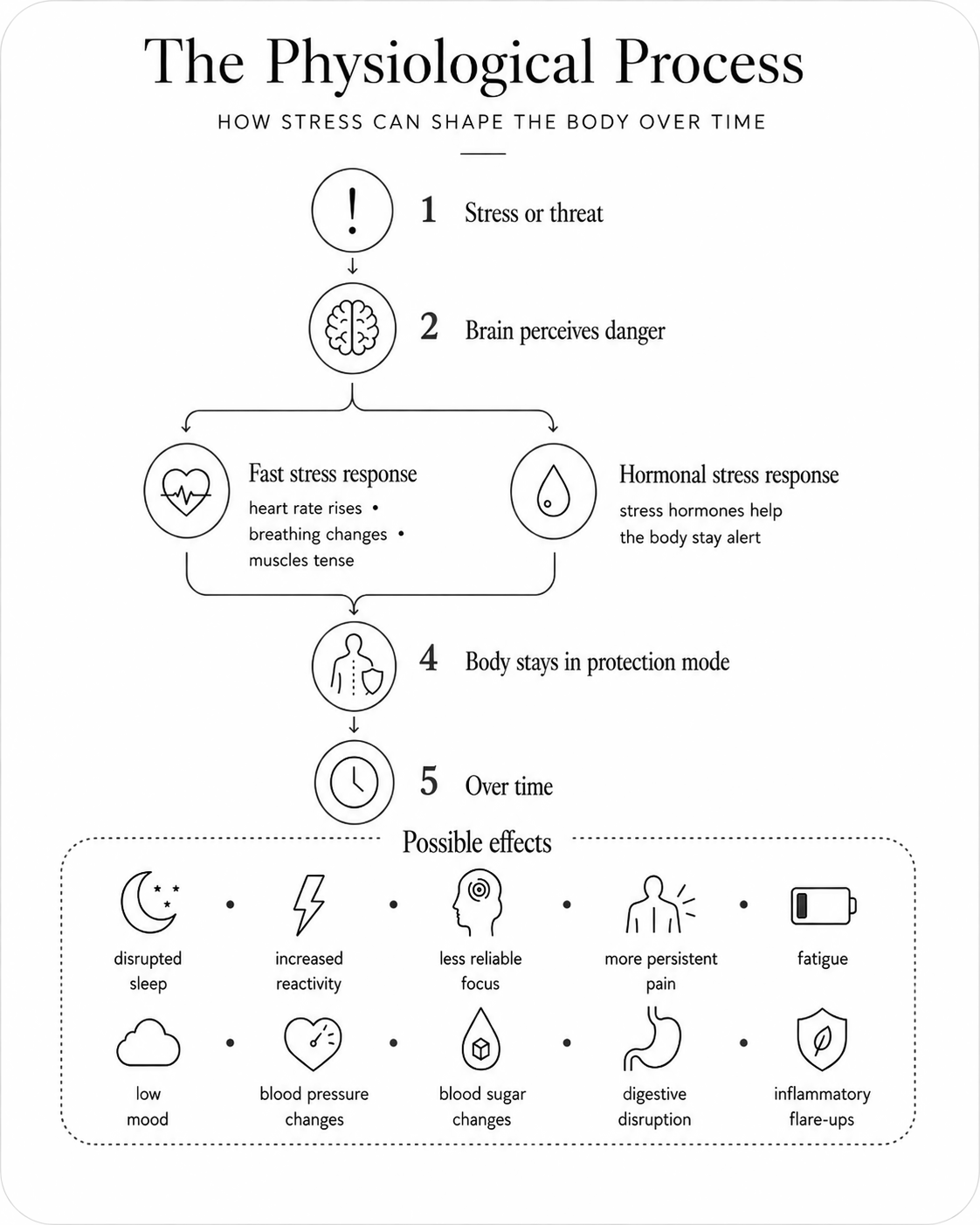
Stress is often treated as if it happens only in the mind, but it's a whole-body response. The moment something feels threatening—an event, a memory, or emotional pressure—the brain begins organizing the body to react: heart rate rises, breathing quickens and shallows, muscles tighten, and digestion slows as energy redirects toward immediate action.
In the short term, this is protective. Once the challenge passes, the body is designed to settle—heart rate slows, breathing steadies, and the system returns toward balance.
The difficulty begins when stress becomes ongoing and the body doesn't fully come out of protection mode. Work pressure, caregiving, grief, chronic pain, and constant overstimulation can all keep the stress response running in the background—showing up over time as disrupted sleep, increased reactivity, less reliable focus, more persistent pain, and difficulty managing blood pressure, blood sugar, digestion, or inflammation. This is why stress can't always be solved by simply "thinking differently"—the body often needs help remembering how to feel safe again.
Yoga therapy works directly with the systems involved in stress. Through breath, movement, relaxation, and meditation, the body receives repeated signals that it's safe to come out of protection mode, supporting steadier recovery, clearer energy, and more ease in daily life.
The Panchakosha Philosophy
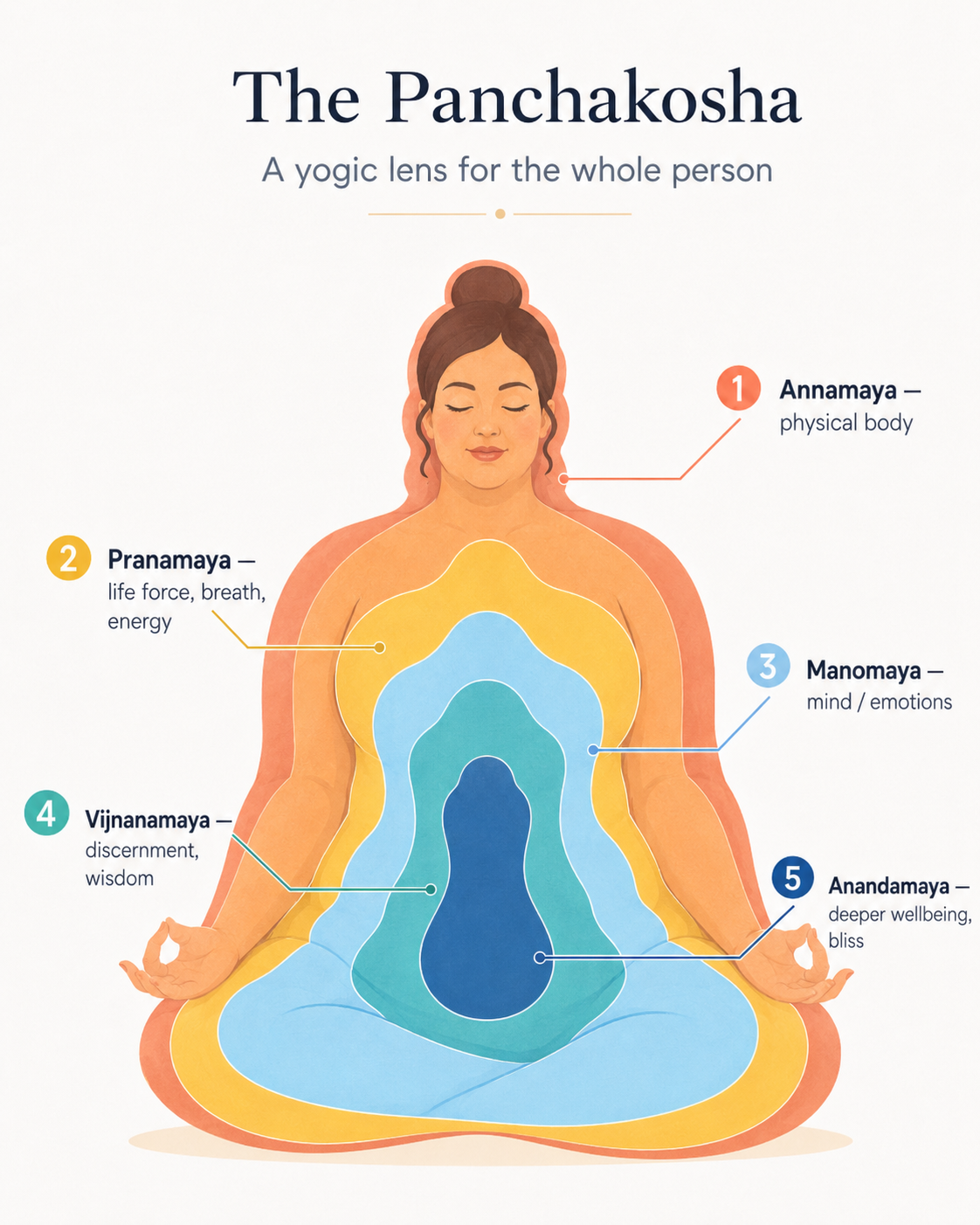
Alongside the physiology, yoga's traditional framework offers another way of understanding a person as a whole: the panchakosha, or five layers of being. Rather than treating body, mind, and spirit as separate, this model sees them as interconnected layers, each shaping the others.
Annamaya kosha — the physical layer: what can be seen, touched, and felt, including tension and physical health.
Pranamaya kosha — the layer of breath and energy: how alive, depleted, or steady you feel.
Manomaya kosha — the mental and emotional layer: thoughts, feelings, and the stories we carry.
Vijnanamaya kosha — the layer of wisdom and discernment: values, intuition, and meaning.
Anandamaya kosha — the innermost layer: a felt sense of ease and connection beneath everything else.
This isn't a checklist—it's a lens. It shapes how I listen during an intake and how a practice is built, so that what we work with is never just a symptom, but the whole person carrying it.
Goal of Yoga Therapy
The goal isn't a perfect practice. It's steadiness—feeling more like yourself, more able to meet what you're carrying, and better equipped to move through it. Sessions are gentle, individualized, and designed to be repeated, because consistency—not perfection—is usually what creates change.
What that looks like depends on what brought you here. For some, it's recovering steadiness during or after cancer treatment. For others, it's finding ground again after a loss, a major life change, or a shift in who they are. For many, it's the accumulated weight of stress that hasn't had anywhere to go. Whatever the starting point, the work is the same: helping a nervous system that's been stuck in protection mode find its way back toward steadiness and ease.

Common Areas of Support
Cancer treatment, recovery, or survivorship:
Whether you're newly diagnosed, mid-treatment, or years into survivorship, cancer often brings a heavy symptom burden—fatigue, disrupted sleep, pain, anxiety, reduced mobility, or a sense of disconnection from a body that no longer feels familiar. A growing body of research supports yoga as a complementary practice during and after cancer treatment, helping with these overlapping symptoms as well as the emotional weight of a diagnosis—the fear, uncertainty, and identity shifts that can come with it. This support isn't only for the person in treatment; caregivers carry their own exhaustion and stress and often benefit just as much from these practices.
Grief or loss:
Grief often settles into the body before it settles into words—showing up as poor sleep, low appetite, heaviness or tightness in the chest, exhaustion, anxiety, or a quiet sense of disconnection from yourself and the world around you. Loss takes many forms—the loss of a child, a parent, a spouse, a pet, a friend, or another loved one—and each carries its own weight. Yoga therapy offers steady support through grief, whatever form it takes and whenever you're ready for it.
A shift in identity or belonging:
This may show up as a loss of confidence, safety, or footing; feeling unlike yourself; or an underlying existential unease. It can follow a career change, a divorce, the process of aging, or LGBTQ+ experiences of transition, rejection, or a loss of safety and belonging—any point where the ground has shifted and who you were doesn't quite fit the life ahead of you yet.
Prolonged stress or overwhelm:
When stress stays "on," it often shows up as tension or pain in the back, neck, or shoulders; poor sleep; irritability; anxiety or depression; fatigue and burnout; headaches; or difficulty concentrating. Chronic stress can also be a contributing factor in cardiovascular disease, arthritis and other inflammatory or autoimmune conditions, and metabolic and weight-related health challenges.
How I work
Here's what that looks like in practice:
A whole-person starting point: Before deciding what practices might be useful, I want to understand what is bringing you to yoga therapy, what is happening in your health and daily life, and what you hope might change. There is no standard sequence that I use for everyone.
Practices adapted to you: Depending on what we are working with, sessions may include movement, breathing practices, relaxation, meditation, or other tools from yoga. These can be adapted for pain, fatigue, mobility, health conditions, or simply for what feels possible on a particular day. You do not need to be flexible or have previous experience with yoga.
Rooted and evidence-informed: My approach is rooted in yoga as a whole-person practice, while also being informed by current research and what we understand about health and the body. I try to use both thoughtfully, without reducing yoga to a set of techniques or applying a practice simply because it works for someone else.
A collaborative, supported process: We will decide together what feels most important to work toward and begin with practices that are realistic for your life. As we continue, we notice what is helping, what is not, and what may need to change. The practice can develop as you do.